
summit
Philanthropy at an Inflection Point: A Conversation with Cari Tuna
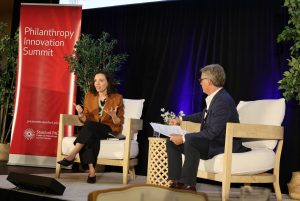
Philanthropy is operating in a moment of profound transition. The challenges it seeks to address, from artificial intelligence and biosecurity to climate change and democratic resilience, are not only global in scope, but increasingly complex, uncertain, and fast-moving. At the same time, questions about the role, legitimacy, and effectiveness of philanthropic capital are becoming more pronounced.
Few leaders have engaged these questions as directly as Cari Tuna. Cari and her husband Dustin Moskovitz have given away more than $5 billion through their foundation, Good Ventures. While the foundation has no staff of its own, Cari and Dustin work closely with the philanthropic funder and advisor Coefficient Giving (formerly Open Philanthropy), which they co-founded and where Cari serves as Chair. Through her work, she has helped advance an approach to giving that emphasizes analytical rigor, long-term thinking, and a willingness to act under uncertainty.
We spoke with Cari about what this moment demands of philanthropy, the evolution behind Coefficient Giving, and how she thinks about the role of philanthropic capital in shaping societal outcomes.
Philanthropy is increasingly operating in areas defined by uncertainty, whether in AI, global health, or climate. From your perspective, what is the comparative advantage of philanthropy in tackling these issues?
The freedom to act in the face of uncertainty and take on risk is one of philanthropy’s most underused, structural advantages. Governments need to justify decisions to voters; businesses answer to shareholders. Philanthropy faces fewer of these constraints. For example, in global health, diseases that disproportionately impact the world’s poorest people persist because private companies don’t have strong financial incentives to invest in treatments and because wealthy country governments are most responsive to the needs of their own constituents.
That’s the kind of gap philanthropy can fill — we have the freedom to support unproven research that might take decades to pan out, ideas that wouldn’t survive a traditional cost-benefit analysis, or work that doesn’t appeal to a wide audience. That freedom isn’t comfortable, exactly — you’re constantly making decisions you can’t fully defend yet. But I find that history bears this approach out. Some of the most consequential philanthropic bets, from research that led to the birth control pill and the technology behind the Green Revolution, looked quite speculative and risky at the time. But a portfolio with one of those successes in it, even alongside other bets that didn’t end up paying off, would still be extraordinary.
Much of your work has emphasized decision-making under uncertainty — acting even when the evidence base is incomplete but the stakes are high. How do you approach that balance between rigor and urgency in practice?
We know that no matter how rigorous we are, many of our bets will not pay off — and we’re okay with that; we’re open to funding work that could fail in order to find a few major wins. For example, some of our science R&D grants have been extraordinary successes, such as our early support for David Baker’s use of AI to accelerate and improve vaccine development. Some of our other science grants have stalled or failed to produce meaningful results. Accepting uncertainty is part of the cost of pursuing high-upside opportunities.
A big part of how we manage that uncertainty is investing heavily in grantmakers with deep expertise and trusting their judgment because they’re closest to the work and best positioned to spot both the risks and the opportunities.
Still, we’re far from having all the answers. One area where I wish we’d moved more quickly is on lead poisoning. We first identified it as a potential focus area in 2019 but for a variety of reasons — including a decision to wait for more data and research — we were slow to act. Lead exposure harms children’s brains and bodies irreversibly, and those are years we can’t get back. I’m proud of how much we’ve ramped up since, including with the support of partners via the Lead Exposure Action Fund. But that one stays with me. Uncertainty doesn’t have to mean inaction, and we try to remind ourselves of that regularly and move faster to spend down our resources.
You recently rebranded from Open Philanthropy to Coefficient Giving. Beyond the name, what has meaningfully shifted in your strategy or philosophy? Does this new direction change how you think about the structure of your giving, for example, the balance between concentration and diversification, or between direct grantmaking and influencing broader philanthropic giving?
When Dustin and I started thinking seriously about giving, there was really no infrastructure for donors like us — people with a lot of resources and no preconceived notions about where or how to give. Most people advised us to focus on our passions. They meant well, but that advice didn’t get us very far. So we built what we wished had existed.
Instead of hiring our own foundation staff at Good Ventures, we partnered with GiveWell to create a separate project, which eventually became Coefficient Giving. Its rigorous research about causes and grant recommendations were always intended to be shared infrastructure—available to not just us, but any donors operating from similar principles.
In the early years, the team was mostly focused on growing its capacity to help Dustin and me give away our resources. But in recent years, as Dustin and I approach a spend-down rate, the organization has been able to expand to serve a wider set of donors, as I had always hoped. In 2025, Coefficient directed over $200 million from donors beyond Dustin and me, and more are joining all the time. Last year was also when our CEO, Alexander Berger, made the decision to change the name to Coefficient Giving to officially mark a new chapter as an explicitly multidonor organization.
This evolution has been tremendously rewarding to see, and it dovetails with my passion for supporting other donors in hitting the ground running. I remember how hard it was 15 years ago when I was getting started, and how valuable the mentorship of other donors and foundation leaders was to me early on. Being able to pay that forward has become one of the most personally meaningful parts of my work.
Plus, it’s more fun to give in partnership with other donors. I enjoy building those relationships and coming together to do something meaningful.
One may argue that philanthropy’s unique contribution is to act as risk capital for society, to support areas that are too early, uncertain, or politically constrained for other sectors. How do you think about where philanthropy should take risks, and where it should be more cautious? What distinguishes productive risk-taking from work that is simply speculative or disconnected from real-world impact?
The honest answer is that the line between a productive bet and pure speculation isn’t always obvious in advance. To meaningfully improve those odds, we employ a systematic approach and look for causes that are important, neglected, and tractable, and try to consider these factors together.
For example, neglectedness alone doesn’t make something worth funding. A problem can be neglected because it’s genuinely hard to make progress on. Often when we’re considering opportunities that involve more uncertainty or risk, we’re looking for evidence that there’s a real path forward: that someone has a credible theory of change, that there are people with the right expertise working on it, that incremental progress is possible even if the ultimate goal is distant. Looking at tractability helps separate a speculative bet from a pure leap of faith.
That said, we don’t have an inherent bias towards high-risk giving. The goal is ultimately to do as much good as we can, and that means funding work across the risk spectrum, from proven interventions like delivering antimalarial medication, to more speculative bets like funding basic science. But it would be a mistake to play it safe entirely and leave some of the biggest opportunities to do good that are neglected by other actors on the table.
Much of the funding in AI has focused on technical safety or “AI for good.” As AI capabilities advance, do you see a role for philanthropy in strengthening institutional capacity across governance, civil society, and public understanding? What might that look like in practice?
We think AI has the potential to be tremendously beneficial — I mentioned our grantee David Baker, who won the Nobel Prize for using AI to design new proteins, which is unlocking new possibilities for vaccines against diseases like flu, syphilis, and hepatitis C. But while there are extremely strong commercial incentives to accelerate AI capabilities, there aren’t comparable incentives to ensure these systems are deployed and integrated safely. I think philanthropy can play a very important role to close that gap.
In practice, Coefficient’s AI safety work focuses on three things. One is increasing visibility into what frontier systems can actually do — that can look like funding evaluations of potentially dangerous capabilities like cyberoffense or biological research, or supporting high-quality journalism about the trajectory of AI development to help inform the public. Another is developing both technical and policy safeguards against worst-case risks, for example, research into detecting misaligned behaviors in AI systems or supporting think tanks working on policy responses. And third is investing in the talent pipeline of people working on AI safety and governance across government, civil society, academia, and more. None of these are sufficient on their own, but together they start to address a gap that markets won’t fill on their own.
Many of the challenges philanthropy is engaging with require coordination across funders and sectors. Where do you think philanthropy struggles most with collective action, and what would it take to improve that?
One thing I’ve noticed over the years is that donors are less interested in reinventing the wheel. They’d like to give away their wealth, but they’re more reluctant to start from scratch, build their own foundations, and develop their own strategies — and I completely empathize with this. It can feel very duplicative. But donors still want to feel confident that when they give, their resources will do an outsized amount of good in the world.
That’s a big part of why Coefficient Giving is built as infrastructure that other donors can plug into. Coefficient’s team offers pooled funds, research, customized learning journeys, and shovel-ready grant opportunities so that philanthropists who are ready to act don’t have to spend years building capacity before they can generate impact. It’s been exciting to see that take shape, including through multidonor efforts like the Lead Exposure Action Fund that I mentioned before, and the Abundance & Growth Fund, which we launched in 2025 to accelerate economic growth and technological progress while lowering the cost of living.
Over the course of your journey, what is something you’ve changed your mind about when it comes to how philanthropy should operate?
For most of my time in philanthropy, my heart was in our global health and development work. That’s where I spent my days, and it felt very tangible to me. I was always glad we had people working on AI safety, but I didn’t fully feel the urgency the way they did. We started funding this work in 2015 — long before the launch of ChatGPT — when the field was quite small, the risks felt speculative to most people, and the timeline to any of it mattering seemed distant.
But year after year, the pace of AI progress kept accelerating, and the urgency became very real to me, too. What changed my mind wasn’t a single argument, but rather watching the evidence of AI progress accumulate, and trusting the colleagues who were closest to it. And to be clear, the urgency I feel on global health issues hasn’t diminished by comparison, particularly as major institutions have pulled back from these causes. But I think the thing I’ve updated on the most is the importance of building an organization where the people with the deepest understanding are empowered to set direction, even when it means moving into territory that feels less intuitive to me personally. We relied on judgment calls from people we trusted who saw a massive, neglected opportunity, and gave them the institutional freedom to act on it early. That’s what I think philanthropy is for.
Looking ahead 5–10 years, what would success look like, not just for Coefficient Giving, but for the broader philanthropic ecosystem in addressing these emerging challenges?
Five or ten years from now, I’d love to see some of the bets we’ve made start to pay off in visible ways — diseases like malaria and tuberculosis on the verge of elimination globally, not just in wealthy countries. I hope our giving will have helped the world navigate transformative AI in a way that’s genuinely good for people, and better than the default trajectory might have been. Those feel ambitious but hopefully not unrealistic.
Most of all, I hope we’ll have done this work alongside a much larger community of donors. One of the things that’s struck me over 15 years of doing this is how much more is possible when donors coordinate, and I’d love for Coefficient to be a meaningful part of that picture. The problems we’re working on are genuinely too big and complex for any of us to solve alone. I think a world where that kind of collaboration is the norm in philanthropy, rather than the exception, is possible, but we’re not there yet.