
summit
Redefining Educational Equity: Neeru Khosla on Philanthropy and the Future of Learning
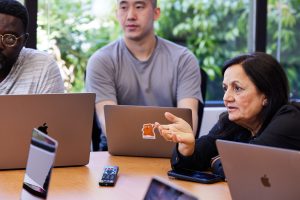
“It is very hard to change systems, but you must keep trying, and do so alongside people who are equally, if not more, committed to making change in whatever issue you care about. There is no one way to do good in the world.” -Neeru Khosla
Neeru Khosla is the Co-Founder and Executive Director of CK-12 Foundation, a not-for-profit organization advancing K-12 STEM education by leveraging the power of AI. CK-12 Foundation’s AI-powered Student Tutor, Teacher Assistant, and Open Content are removing barriers to access by providing the best content delivered through cutting edge technology which is free for all. CK-12 has served over 317M+ learners since its founding in 2007 and continues to provide free learning tools to over 700,000 students each month across 60+ countries.
Neeru is an alum and former advisory board member of the Stanford Graduate School of Education. She has volunteered for various educational initiatives, including as an advisory board member for The Nueva School’s Board of Trustees, the Board of Directors for High Tech High School’s Graduate School of Education, the Advisory Board for IDEO.org, the Advisory Board for DonorsChoose.org, and as one of the founding members of the K-12 Initiative of the Design School (Hasso Plattner Institute of Design) at Stanford.
We had a wide-ranging conversation with Neeru on the impetus for CK-12 and how philanthropy can provide catalytic capital to strengthen public infrastructure and address educational inequities.
What inspired you to start CK-12? Can you share your personal journey and the pivotal moments that shaped your path into education and philanthropy?
My journey into education and eventually founding CK-12 was shaped by personal experiences across vastly different learning environments. I was born in India and as a child, I briefly lived in London where I encountered a student-centric, creative approach to learning that was in contrast to the rigid education system I returned to in India. That shift made me deeply aware of how different educational systems can affect a student’s potential.
I moved to the U.S. as an adult and worked at a Stanford lab conducting gene expression research. I had to step away once I was expecting my first child due to safety concerns with radioactivity at the lab. Unsure of my next step, I kept returning to the idea of education, something my parents and grandparents had always emphasized as a pathway out of limited circumstances. I went back to school to earn a Masters’ degree at the Stanford School of Education. There I began exploring what public school students were struggling with and saw firsthand the inequities in education, especially the challenges of one teacher trying to meet the needs of 30 or more students at our public schools. The search for a solution to educational inequity is what sparked CK-12, a way to use technology to provide high-quality, adaptable learning resources at scale.
We launched in 2007 with the goal of creating free, flexible content that is offered in a way that makes it more meaningful for young learners. Unlike static content, we created products that meet students where they are, develop a holistic understanding of the gaps and opportunities in their learning curve, and provide customized solutions for their needs, whether they need to catch up or move ahead. It came from a deep understanding that children’s learning occurs as a continuum, with their family, their environment and whatever else they have access to. The one-size-fits-all model will leave more children behind, exacerbating inequities in society. Over time, we’ve built tools that help trace students’ understanding, offering insights for both teachers and learners. It’s about empowering teachers to personalize instruction and ensuring every student, regardless of background, has the chance to succeed.
What have been the biggest roadblocks that you have encountered in this journey?
The biggest challenge in education reform is systems inertia. We need a holistic approach to reimagining education alongside teachers, administrators and policymakers. There is no better time to do this, especially as public school infrastructure is still struggling in the aftermath of COVID. We have a unique opportunity to leverage technology to provide unprecedented personalized teaching assistance to all children. And to provide teachers with tools that allow them to deeply understand each student and meet their needs, without taxing them even more. Teachers in public schools are expected to do so much more than just deliver content and teach the curriculum. Technology can help alleviate some of these pressures and make teaching a joy again. It can also save school districts hundreds of thousands of dollars per year that can go to teachers and supporting other student resources. But it has to be technology that is custom built for teachers and students, and is designed to adapt to their specific needs. This is where philanthropy comes in. Commercial technology is currently not built to serve this particular demographic’s needs. In order to truly serve the needs of the most disadvantaged, philanthropy can act as risk capital to not only develop custom technological solutions, but also support training and adoption at scale.
As a philanthropist, what core values guide your decisions and investments? What does meaningful impact look like to you?
I believe that it is a privilege to have the opportunity to serve others and I believe deeply in education as a true lever in changing people’s lives. And if it is possible to do something at a systemic level, that is truly the way to serve the most people. But it is important to be honest with yourself and assess whether what you are doing has impact and is relevant and useful for the context that you are working in. I believe in the potential of every young person and we have a duty to give them what they need to create, collaborate and contribute to society. And so, my philanthropic efforts have solely been focused on creating and distributing educational resources that can benefit young people.
Your foundation has been at this for 17 years now. What have you learned and what would you share with philanthropists early in their journeys?
One of the things I’m most proud of is how CK-12 has directly impacted students, especially those who felt left behind in traditional classrooms. I’ve heard from kids who used our Flexi lessons over the summer and went from struggling in science to feeling confident and caught up when the school year started. They were able to learn at their own pace. That kind of transformation is incredibly meaningful. I encourage philanthropists to find a way to listen to beneficiaries.
The other thing I want to mention is that when I started CK-12, I didn’t have a background in technology. I had to learn as I went, which proves that anyone at any age is capable of starting something transformative. So I urge you to start somewhere.
Lastly, it is very hard to change systems, but you must keep trying, and do so alongside people who are equally, if not more, committed to making change in whatever issue you care about. There is no one way to do good in the world.